
TL;DR
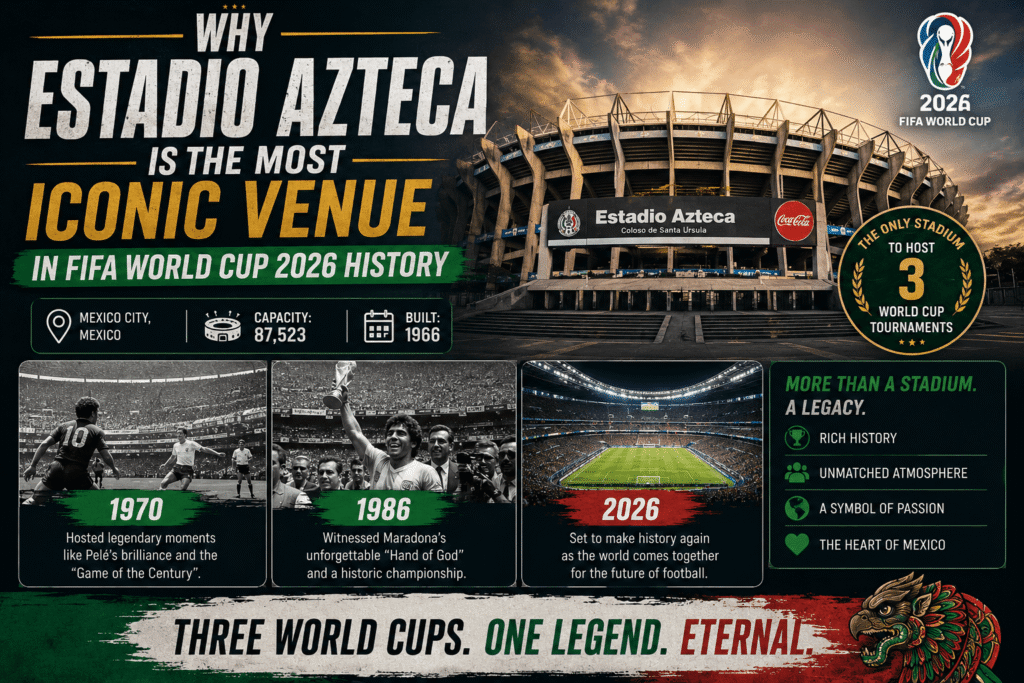
- Estadio Azteca is the only stadium in history to host matches at three FIFA World Cups – 1970, 1986, and now 2026.
- It hosted both the “Game of the Century” (Italy 4-3 West Germany, 1970) and the “Goal of the Century” (Maradona vs England, 1986) – no other stadium holds two moments of that scale.
- For the 2026 tournament, the Azteca opened the competition on June 11 with Mexico vs South Africa, continuing a tradition no other venue can claim.
- After a $201.7 million renovation (FIFA, 2026), the stadium now holds 87,523 spectators at an altitude of 2,200 metres above sea level.
- No stadium at the 2026 World Cup comes close to the Azteca’s depth of football history.
What Makes Estadio Azteca the Most Iconic World Cup Stadium?
Estadio Azteca is the only venue ever to host World Cup matches at three separate tournaments. Of the 16 stadiums used at the 2026 FIFA World Cup across the United States, Mexico, and Canada, every other ground is appearing on this stage for the first time. The Azteca has been here twice before – and both times, it produced moments that football has never stopped talking about.
Built in 1961 and opened on May 29, 1966 (Wikipedia), the stadium was designed by Mexican architects Pedro Ramírez Vázquez and Rafael Mijares Alcérreca with one explicit goal: to host the 1970 FIFA World Cup. It did that. Then it did it again in 1986. And in 2026, it does it a third time.
The Stadium’s World Cup Record: Three Tournaments, No Other Venue Comes Close
The Azteca is unique among all 2026 World Cup venues in that it has previously hosted not one, but two World Cup finals. That alone puts it in a category by itself. Add a third hosting turn in 2026, and the gap between the Azteca and every other stadium in football widens further. Yahoo Sports
Here is the Azteca’s World Cup hosting record at a glance:
| Tournament | Role | Notable Match |
|---|---|---|
| 1970 FIFA World Cup | Host stadium, Final venue | Game of the Century (Italy 4-3 West Germany); Brazil 4-1 Italy Final |
| 1986 FIFA World Cup | Host stadium, Final venue | Maradona’s Hand of God + Goal of the Century vs England |
| 2026 FIFA World Cup | Host stadium, Opening match venue | Mexico vs South Africa (June 11, 2026) |
The Azteca will make history by becoming the first venue ever to host three FIFA World Cup opening matches. No other ground has opened a World Cup more than once. beIN SPORTS
The Game of the Century: Italy 4-3 West Germany (June 17, 1970)
The Azteca’s reputation as a stage for extraordinary football started on June 17, 1970. The semi-final between Italy and West Germany is known as the “Game of the Century.” Italy won 4-3 after five goals were scored in extra time – the only FIFA World Cup game in which this has happened. WordPress
Italy led 1-0 for the majority of the match, after Roberto Boninsegna scored in the 8th minute. In the 70th minute, West German defender Franz Beckenbauer dislocated his shoulder, but stayed on the field carrying his dislocated arm in a sling, as his side had already used their two permitted substitutions. Wikipedia
Karl-Heinz Schnellinger equalized in the final minute of regular time to force extra time. Five goals then followed in 30 minutes – a record for World Cup extra time that still stands (Wikipedia, 1970). Italy won 4-3. On the outside wall of the Estadio Azteca sits a plaque which commemorates the match. It has been there for over five decades. The Analyst
The 1970 FIFA World Cup final was held on June 21 in the Estadio Azteca in Mexico City, where Brazil beat Italy 4-1 in front of 107,412 supporters, and Pelé lifted his third World Cup title. The same stadium, one tournament. Two matches the sport will never forget. Wikipedia
The Goal of the Century: Maradona vs England (June 22, 1986)
Sixteen years later, the Azteca produced something football still cannot fully explain. The 1986 FIFA World Cup quarter-final between Argentina and England, played on June 22 at Mexico City’s Estadio Azteca, is remembered as one of the most iconic matches in football history. The two nations had fought the Falklands War just four years earlier, a conflict that left more than 600 Argentine soldiers dead. Hudson Reporter
Diego Maradona, 25 years old and at the absolute peak of his powers, first punched the ball into the net with his left hand and then dribbled past five defenders across 60 metres to score what FIFA voters would later name the “Goal of the Century” in a 2002 online poll. Argentina won 2-1. Worldfootballjourney
Both goals happened within four minutes of each other. Maradona’s post-match explanation coined the phrase that entered football folklore: “It was partly the hand of God, partly the head of Maradona.” The Footy Feed
The Estadio Azteca later erected a statue of Maradona frozen in the moment of that run, placed at the entrance to the ground. It remains there today. Worldfootballjourney
Argentina went on to win the 1986 World Cup. The Azteca hosted that final too – its second consecutive World Cup final on the same turf.
Architecture and Design: Built to Last 60 Years and Counting
Inaugurated on May 29, 1966, with a match between Club América and Italy’s Torino, the stadium is located in the south of Mexico City. At the time of its opening, the stadium welcomed 110,000 spectators. ColombiaOne
The design by Ramírez Vázquez was deliberate. The original vision was to design a space to host massive events of any nature, a flexibility that remains its greatest operational strength. That flexibility meant the Azteca has hosted the 1968 Olympics, NFL matches, papal visits, and concerts by Paul McCartney, Michael Jackson, Shakira, and Karol G across six decades. ColombiaOne
The stadium sits at 2,200 metres above sea level (Wikipedia) – a factor that has influenced the outcome of matches played there throughout its history. Players and fans travelling to the 2026 World Cup are advised to arrive 24-48 hours early to acclimatize (KickoffAdventures, 2026).
The record attendance at the Azteca for a football match stands at 119,853 for Mexico vs Brazil on July 7, 1968. No other football ground has hosted a larger verified crowd. Wikipedia
The 2026 Renovation: What Changed Before the Third World Cup
Ahead of the 2026 FIFA World Cup, Estadio Azteca underwent significant upgrades. Renovations included the restoration of the stadium’s facade and the installation of LED lighting. New changing rooms under the boxes and a tunnel for the players were created. High-resolution LED screens were installed throughout the stadium, and the seats in the stands were replaced. StadiumDB
The most recent intervention represented an investment of nearly 3,500 million Mexican pesos – approximately US$201.7 million. The project was supervised by the global sports design firm Populous and included facial recognition security systems to meet FIFA’s 2026 protocols. ColombiaOne
The redevelopment also redesigned the entrances and facade to improve visitor flow. For the tournament, the stadium operates with a capacity of 87,523 spectators (FIFPlay, 2026). StadiumDB
During the 2026 tournament, FIFA refers to the venue officially as “Mexico City Stadium.” Outside the tournament, its traditional name, Estadio Azteca, pays tribute to the Aztec heritage of Mexico City. The stadium also carries a title sponsor and is officially known as Estadio Banorte. StadiumDB
What the Azteca Hosted at the 2026 FIFA World Cup
Mexico City Stadium hosted five matches across the tournament, including the opening game on June 11 – Mexico vs South Africa in Group A at 3:00 PM ET. beIN SPORTS
The full schedule:
| Date | Match | Stage |
|---|---|---|
| June 11, 2026 | Mexico vs South Africa | Group A – Opening Match |
| June 17, 2026 | Uzbekistan vs Colombia | Group K |
| June 24, 2026 | Mexico vs UEFA Playoff D | Group A |
| June 30, 2026 | Round of 32 fixture | Round of 32 |
| July 5, 2026 | Round of 16 fixture | Round of 16 |
How to Get to Estadio Azteca for 2026 World Cup Matches
The stadium is not walkable from Mexico City’s centre. Ticket holders using public transport can take Metro Line 2 to Tasquena station, then the Xochimilco Light Rail to Estadio Azteca station. FourFourTwo
Fans driving should book parking well in advance – spaces are limited and fill fast on matchdays. Given Mexico City traffic and the stadium’s location in the south of the city, arriving three hours before kickoff is the standard recommendation for major international fixtures (KickoffAdventures, 2026).
The altitude at 2,200 metres means the air is noticeably thinner than at sea level. Hydrating well and avoiding heavy meals before matches will make the experience more comfortable, particularly for fans travelling from low-altitude countries.
Common Mistakes Fans Make When Visiting the Azteca
- Arriving too late: The Azteca’s transport links handle high volumes well, but security queues at World Cup level can take 45 minutes or more. Three hours before kickoff is the minimum, not the suggestion.
- Skipping acclimatization: Travelling directly from a sea-level city and attending a match the same day is hard on the body. The 2,200-metre altitude affects breathing and energy noticeably. A 24-48 hour adjustment period before the match makes a real difference.
- Ignoring the stadium’s history on arrival: The Maradona statue at the entrance and the Game of the Century plaque on the outer wall are worth seeing before going inside. Build in 20 minutes before the gates open.
Frequently Asked Questions About Estadio Azteca and FIFA World Cup 2026
What makes Estadio Azteca unique among all FIFA World Cup 2026 stadiums?
The Azteca is the only stadium at the 2026 World Cup that has hosted previous World Cup tournaments. It held the 1970 and 1986 World Cups, including the finals of both. Every other stadium in the 2026 tournament is appearing at a World Cup for the first time.
How many World Cups has Estadio Azteca hosted?
Three. The Azteca hosted the 1970 FIFA World Cup, the 1986 FIFA World Cup, and the 2026 FIFA World Cup. It is the only venue in history to host World Cup matches at three separate tournaments.
What is the capacity of Estadio Azteca for the 2026 FIFA World Cup?
The stadium operates at 87,523 seats for the 2026 tournament, following a $201.7 million renovation completed ahead of the competition (FIFA, 2026). This makes it one of the largest venues in the entire 2026 tournament.
What is the “Goal of the Century” and why did it happen at the Azteca?
The “Goal of the Century” refers to Diego Maradona’s solo goal against England in the 1986 World Cup quarter-final on June 22, 1986. Maradona received the ball in his own half and dribbled 60 metres past five defenders before scoring. FIFA held a global vote in 2002 and it won by a large margin. It happened at the Azteca because the stadium was the host venue for the 1986 World Cup in Mexico City.
What is the altitude of Estadio Azteca and does it affect matches?
The stadium sits at 2,200 metres (7,200 feet) above sea level. This altitude reduces oxygen availability compared to sea-level stadiums and has historically affected players’ stamina and the physical intensity of matches. Fans and athletes travelling to 2026 World Cup fixtures at the Azteca are advised to arrive 24-48 hours early to acclimatize.
How many matches did the Azteca host at the 2026 FIFA World Cup?
Five matches – one opening group game (Mexico vs South Africa, June 11), two further group stage games, one Round of 32 fixture, and one Round of 16 fixture.
What was the record attendance at Estadio Azteca?
The highest verified attendance for a football match at the Azteca was 119,853 for Mexico vs Brazil on July 7, 1968 (Wikipedia). For boxing, a 1993 bout between Julio César Chávez and Greg Haugen drew 132,247 – the largest crowd ever recorded at the ground.
Key Takeaways
- The Azteca’s status comes from one fact no other stadium can match: it has hosted three FIFA World Cups, including the finals of both 1970 and 1986.
- The two greatest individual moments in World Cup history – the Game of the Century and Maradona’s Goal of the Century – both happened on the same pitch, 16 years apart.
- After a $201.7 million renovation, the stadium opened the 2026 World Cup on June 11 with Mexico vs South Africa, extending a record that no other football ground will match for the foreseeable future.