TL;DR
- India remains without a confirmed broadcaster for the 2026 FIFA World Cup, which starts June 11, 2026 – making it one of the last major markets without a deal.
- China resolved its standoff on May 15, 2026, when China Media Group (CMG) signed a deal with FIFA for approximately $60 million.
- The core problem in India: FIFA initially asked for $100 million; the biggest offer on the table was $20 million from JioStar (Reuters, 2026).
- Match kickoff times between midnight and 8:00 AM IST make it financially unattractive for Indian broadcasters to pay premium rights fees.
- Amazon Prime Video and YouTube Premium are being discussed as last-minute digital options for India, but no deal is confirmed as of May 23, 2026.
What Is the FIFA World Cup 2026 Broadcast Crisis?
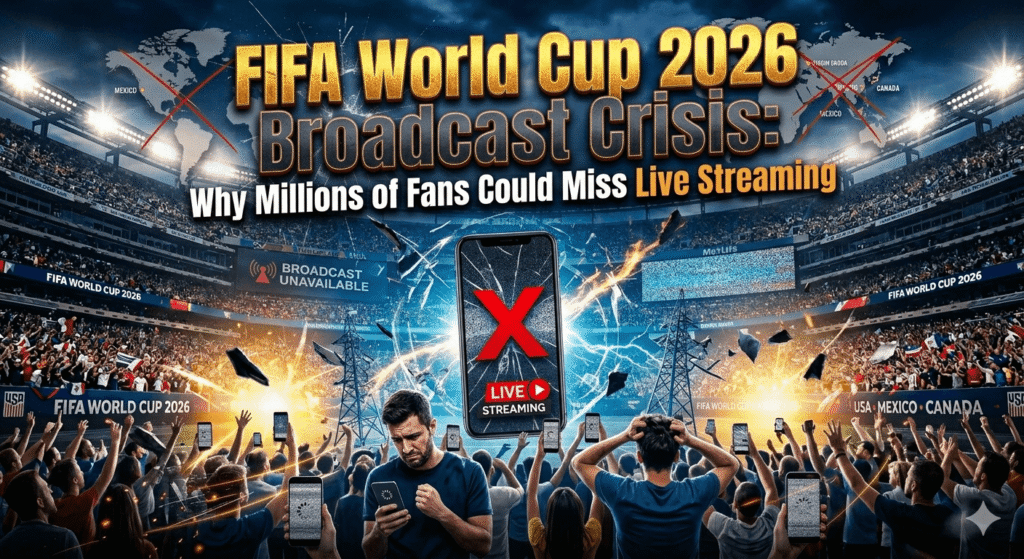
The 2026 FIFA World Cup broadcast crisis is a standoff between FIFA and broadcasters in the world’s two most populous nations – India and China – over the price of live streaming and television rights. With the tournament starting June 11, 2026, India still has no confirmed broadcaster, leaving over 1.4 billion people potentially locked out of legal access to 104 matches.
China resolved its side of the dispute on May 15, 2026, when China Media Group (CMG), the parent body of state broadcaster CCTV, formally announced a comprehensive media rights agreement with FIFA. India has not. As of May 2026, no Indian broadcaster has secured rights to the tournament – an extraordinary situation for one of the world’s largest and fastest-growing football markets. Outlook IndiaThe Dakia
This is not a minor administrative delay. It is a pricing standoff that puts hundreds of millions of cord-cutters and streaming users at real risk of having no legal way to watch the world’s biggest sporting event.
Why India Has No World Cup Broadcaster Yet
India’s broadcast crisis comes down to one thing: a gap between what FIFA wants and what Indian media companies will pay.
FIFA initially sought close to $100 million for the combined India media rights package for the 2026 and 2030 World Cups. The valuation was later reportedly reduced to around $35 million, but broadcasters have still not agreed to the terms. JioStar – the platform formed through the Reliance-Disney merger – reportedly offered $20 million for 2026 alone. FIFA rejected it. Storyboard18
Sony also entered discussions. Sony was in contention but backed out after FIFA, per reports, rejected its offer of $10 million for the broadcast rights in India. Wionews
The deeper issue is timing. Unlike the prime-time slots of Qatar 2022, the 2026 matches in the US, Canada, and Mexico will largely occur between 12:00 AM and 8:00 AM IST. Broadcasters are hesitant to pay premium prices for slots that offer diminished advertising revenue. Yardbarker
Think of it like buying billboard space on a highway that most people only drive at 3 AM – the audience is real, but advertisers will not pay peak rates for it. That makes the math hard for any Indian broadcaster to justify.
What Happened to JioCinema’s Success in 2022?
India delivered strong digital engagement during the 2022 FIFA World Cup – when Viacom18 held rights for a reported $60 million and JioCinema recorded over 110 million viewers, including 32 million for the final. That same goodwill has not translated into a 2026 deal, because the economic conditions are fundamentally different. Storyboard18
In 2022, matches kicked off at 6:30 PM, 9:30 PM, and midnight IST – workable hours for a mass audience. In 2026, the bulk of group-stage games start between midnight and 5 AM IST. Advertisers know viewership at those hours drops sharply, and broadcasters are pricing accordingly.
How China Resolved Its Broadcast Dispute
China’s resolution shows what a deal looks like when both sides move enough to meet.
FIFA reportedly lowered its initial $250 million valuation to meet the shifting economic realities of the Chinese media landscape. Reports from state-backed outlet The Paper indicate that the rights for the 2026 tournament alone cost approximately $60 million. YardbarkerOutlook India
CMG will use its massive network, spanning free-to-air television, digital platforms, and mobile apps, to provide 4K and 8K coverage of the expanded 48-team tournament. The deal also covers the 2030 World Cup and the Women’s World Cups in 2027 and 2031. Yardbarker
FIFA says China accounted for 49.8 percent of all hours of viewing on digital and social platforms globally during the 2022 World Cup. That figure gave FIFA strong incentive to close a deal, even at a reduced price. India’s numbers were also significant, but its broadcasters were not willing to meet FIFA even halfway. Al Jazeera
Where Cord-Cutters Can Watch the 2026 World Cup Right Now
FIFA already has broadcast agreements with 175 countries locked in. FOX Sports holds the rights in the US, while BBC Sport and ITV share coverage in the UK. In Australia, SBS is the home of the tournament. Sports Illustrated
For cord-cutters specifically, here is the current picture by region:
| Region | Broadcaster | Streaming Option |
|---|---|---|
| United States | FOX Sports | FOX Sports app, Fubo, Hulu + Live TV |
| United Kingdom | BBC / ITV | BBC iPlayer, ITVX |
| Australia | SBS | SBS On Demand |
| China | CMG / CCTV | CCTV+ digital platforms |
| Brazil | CazéTV | YouTube (free, all matches) |
| India | Not confirmed | No legal option confirmed as of May 23, 2026 |
Brazil is worth noting: YouTube extended its deal with FIFA and CazéTV to show all tournament games for free in Brazil. That is a rare case of a fully free, legal streaming option for every match. Wikipedia
What Is FIFA’s YouTube Deal and Does It Help Indian Fans?
FIFA announced YouTube as a “Preferred Platform” for the 2026 tournament. The agreement allows official media partners to stream the first 10 minutes of every match on their YouTube channels and also stream select full matches, along with highlights and behind-the-scenes content. Wikipedia
That arrangement does not automatically make YouTube an India rights holder. Indian fans watching YouTube streams from Brazilian or other channels would be accessing content not licensed for their territory – a legal grey area that FIFA could choose to geo-block at any point. Best Media Info
What Indian Fans Can Realistically Expect Before June 11
Three scenarios are in play as of May 23, 2026.
Scenario 1: A last-minute digital deal. Amazon Prime and YouTube Premium are being seen as possible digital contenders for streaming the FIFA World Cup 2026 in India. JioStar’s proposal for digital rights was not accepted, and Doordarshan offered about Rs 5 crore for knockout-stage matches only. A digital-first deal – where a streaming platform pays a smaller fee for online-only rights – is the most likely path to resolution. Best Media Info
Scenario 2: A court-mandated public broadcast. The lack of a confirmed television or digital rights partner for India has reached the Delhi High Court. On May 11, the court issued a notice to public broadcaster Prasar Bharati after a petition sought directions to ensure the tournament is aired on free-to-air platforms such as Doordarshan and DD Sports. If the court acts, Indian fans may get access through state television – though coverage quality and match selection would be uncertain. Storyboard18
Scenario 3: No deal, no legal stream. If neither happens before June 11, Indian fans face a legal blackout for the full group stage. YouTube is expected to stream select content, including highlights and partial match coverage under a March 2026 agreement, while FIFA+ remains available as the organisation’s direct-to-consumer platform. Neither offers full live matches. Storyboard18
Why This Crisis Matters Beyond India
The India standoff is not just a local problem. It signals a structural tension in how FIFA sells rights globally.
FIFA sold rights territory by territory rather than through a single global package. FIFA has earned close to four billion dollars from broadcasting revenue in this cycle alone. That model works well in markets with favorable match times and strong advertiser demand. It breaks down in markets where the local economics do not align with FIFA’s valuations. The Dakia
The 2026 World Cup is the first 48-team edition, with 104 matches spread across three countries in the Americas. The expanded 48-team format means more matches, more simultaneous broadcast windows, and a more complex web of broadcast rights than any previous edition. More matches mean more time zones to satisfy – and more mismatches between FIFA’s pricing expectations and market realities. The Dakia
For cord-cutters around the world, this is a warning: legal access to live sport is not guaranteed, even for the biggest events on Earth.
Frequently Asked Questions About the FIFA World Cup 2026 Broadcast Crisis
What is the FIFA World Cup 2026 broadcast crisis?
It is an ongoing dispute over television and streaming rights that left India – home to 1.4 billion people – without a confirmed broadcaster weeks before the tournament started on June 11, 2026. China resolved its own standoff on May 15, 2026, when China Media Group signed a deal with FIFA for approximately $60 million (The Paper, 2026).
Why can’t Indian fans watch the 2026 World Cup?
No Indian broadcaster has agreed to FIFA’s asking price for streaming and TV rights. The biggest offer on the table was $20 million from JioStar; FIFA’s floor price was around $35 million (Reuters, 2026). The gap has not closed, and match kickoff times between midnight and 8 AM IST make high advertising revenue – which would justify a bigger rights fee – unlikely.
How does the FIFA YouTube deal work for cord-cutters?
FIFA designated YouTube as a “Preferred Platform” for the 2026 tournament. Official media partners can stream the first 10 minutes of every match on their YouTube channels and select full matches (FIFA, 2026). This does not give fans in unlicensed territories – like India – full legal access to live games.
Where can cord-cutters in the US stream the 2026 World Cup?
FOX Sports holds US rights. Cord-cutters can access matches through the FOX Sports app with a cable login, or through live TV streaming services including Fubo, Hulu + Live TV, and YouTube TV, all of which carry FOX channels.
Will the 2026 World Cup be free to watch anywhere?
Yes – in Brazil. YouTube extended a deal with FIFA and local broadcaster CazéTV to stream all 104 tournament matches for free on YouTube in Brazil (FIFA, 2026). No other major market has a comparable free-to-air streaming arrangement for every match.
What happens if India still has no broadcaster on June 11?
Indian fans would have no confirmed legal option for live streaming full matches. FIFA+ offers some tournament content directly, and YouTube carries the first 10 minutes of every match globally. A Delhi High Court order directing Prasar Bharati (Doordarshan) to broadcast matches could change this – but no ruling has been issued as of May 23, 2026.
Could Amazon Prime Video or YouTube Premium save Indian fans?
Both platforms are being discussed as last-minute options, per Times Now (2026). A digital-only deal – where one platform pays a reduced fee for streaming rights only, bypassing traditional TV – is the most realistic near-term path to a resolution. No deal has been confirmed.
Key Takeaways
- India is the only major global market still without a confirmed broadcaster for the 2026 FIFA World Cup, which begins June 11.
- China closed its deal on May 15, 2026, with China Media Group paying approximately $60 million for rights.
- The India standoff is driven by a $15+ million gap between FIFA’s floor price and what broadcasters will pay, compounded by late-night match schedules that reduce advertising value.
- US cord-cutters have multiple legal options including FOX Sports, Fubo, and Hulu + Live TV.
- Brazil is the only major market where all 104 matches stream free and legally on YouTube.
- Amazon Prime Video and YouTube Premium remain unconfirmed but are the most likely digital solutions for India before kickoff.